17 July 2026
Employer of Record in Greece
Our Greek lawyers can help you in the process of selecting the services of an employer of record in Greece or of a PEO in Greece.

Foreign companies, especially those who did not have previous connections to Greece, can benefit from the qualifications of the employer of record in Greece. If you need information on the latest employment regulations, our law firm in Greece remains at your service.
| Quick Facts | |
|---|---|
| What is the employer of record in Greece? | The employer of record in Greece is an entity that can be hired by other companies (including foreign companies) to represent them in any matters related to employment. Thus, the employer of record (EOR) will become the official employer for their client companies. |
Elements in the employment contract | – the salary, – the work activities to be carried out by the employees, – the work schedule, – the location where the employment takes place, – the duration of the contract, – the type of contact, etc. |
Probationary period in Greece | 6 months |
| Income tax rates | – 9% (income up to EUR10,000), – 20% (between EUR10,001 and EUR20,000), – 26% (between EUR20,001 and EUR30,000), – 34% (between EUR30,001 and EUR40,000), – 39% (between EUR40,001 and EU 60,000), – 44% (above EUR60,000). Individuals under the age of 25 earning less than EUR20,000 are exempt from income tax. |
| Social security contributions | 35.16% (13.37% – the employee and 21.79% – the employer) |
| Retirement age in Greece | 67 years old, for both men and women |
| Annual leave | 20 to 26 days (5-day week) |
| Paternal leave | 14 days |
| Employer of record services | – preparing employment contracts, – recruiting employees, – assisting in the employment of foreign workers (visas, residency permits and other approvals), – payroll |
| Remote employment management (YES/NO) | Yes |
| Working hours | 5 days of work per week (40 hours of work) |
| Sick leave payment | Employees can reiceve 50% of their daily wage if the sickness lasted for maximum 3 working days. For sickness that lasts longer, employees are entitled to their full daily salary payment (minus the sickness allowance granted by the insurer). |
| Terms of contract termination | Employment contracts can be terminated by both parties. Some of the reasons are: – misconduct, – redundancy, – poor performance, – the expiration of the contract. It is also possible to end an employment contract by mutual agreement between the parties. |
| Why choose our employer of record services in Greece | Having a third party specialized in employment can offer the client company the possibility of focusing on other parts of the business. The Greek employer of record is familiarized with the local employment laws and taxes, can find suitable employees and offers dedicated human resources services, as per the needs of the client. |
| Additional services provided by our team | – tax minimization, – tax reporting and compliance, – legal advice, etc. |
What is the employer of record in Greece?
The Greek employer of record (EOR) refers to a legal entity that is based in Greece and which provides human resources services to third parties, such as foreign companies that need to hire local workforce. By selecting the services of the EOR, the foreign company does not need to handle its employment-related obligations in Greece, as these are outsourced to the EOR, which is specialized in these matters.
What is the law regulating the employer of record in Greece?
This type of business activity is established under the Law 2956/2001. Later on, it was changed into the Law 4052/2012 that implemented the European Union’s regulations (Directive 2008/104). Our attorneys in Greece can provide information on the current applicable regulations.
How can a company operate as an employer of record in Greece?
Investors who want to open a business in Greece can expand their operations on the human resources market. There are many activities that can be developed in this industry, including operating as an employer of record. In order to have the right to carry out this business activity, companies need to hold proper licenses. For licensing purposes, investors must present the following paperwork:
- proof of being registered as a legal entity in Greece;
- the company’s articles of association;
- proof of having a registered address;
- an application form signed by the person who has been appointed as the company’s managing director;
- a clean criminal record issued by competent authorities for the managing director.
What are the responsibilities of the employer of record in Greece?
The Greek employer of record (EOR) has a set of responsibilities when it comes to hiring local workforce on behalf of a company. In the list below, our team of Greek lawyers has highlighted some of the main responsibilities:
- taking care of selecting workforce as per the needs of the company;
- hiring local employees following the rules of the employment law;
- the employment contract is signed through the EOR, which holds full responsibility for it;
- the same applies for human resources matters, thetaxation of employees, payroll;
- if the company will hire foreign workforce, the EOR will deal with matters related to immigration (visa application, residence permits, etc.).
We invite you to watch a short video about the Greek Employer of Record:

Who is the official employer of the Greek workforce?
While foreign companies are the ones that create job opportunities in Greece, if they will handle the employment matters through the EOR, the official employer of these workers is the Greek EOR, which is responsible for all legal issues deriving from employment.
How can your team assist me in starting an EOR business in Greece?
Our team of lawyers in Greece can offer the necessary legal support in order to incorporate a legal entity in this country. Our basic company registration services include:
- obtaining a trade name;
- preparing the company registration file, which includes the mandatory documentation for the incorporation;
- registering the company by following the required incorporation steps;
- obtaining a company stamp;
- opening a bank account;
- obtaining a registered address.
What are the fees charged by your team for EOR company registration services?
Our law firm in Greece charges EUR 2,600 for the registration of a limited liability company (the fee includes the basic incorporation steps – registered name, submission of documents, incorporating the legal entity, securing a company stamp). If you want us to assist you in finding an office space, this service costs EUR 950. We advise you address us for more details on our full list of services and fees.
What are the employment tax rates in Greece?
Greece applies a progressive tax system to employment contracts (the higher the annual income, the higher the tax rate). The lowest tax rate is 9%, applied to income below EUR 10,000. Other taxes are: 20%, 26%, 34%, 39% and 44% (the latter is applied to yearly income above EUR 60,000).
What are the most important matters regarding employment in Greece?
Our law firm in Greece presents the main obligations deriving from an employment contract, as per the applicable rules. Below, you can find out some of the main aspects foreign companies should know:
- the law stipulates that the statutory working week (for full-time contracts) is 40 hours (8 hours per day);
- overtime is defined as work activities beyond 45 hours per week, for contracts where the working week is comprised of 5 days, and to 48 hours per week for contracts with 6 working days;
- where overtime applies, the employee has to be paid 40% more, calculated from the standard salary per hour;
- the basic yearly leave is 20 days per year (vacation leave) for contracts of 5 days of work per week;
- the number of free days will increase based on the number of years worked – after 10 years, the employee is entitled to 25 days.
What is the probationary period in Greece?
According to the Greek law, the probation period can be maximum 6 months.
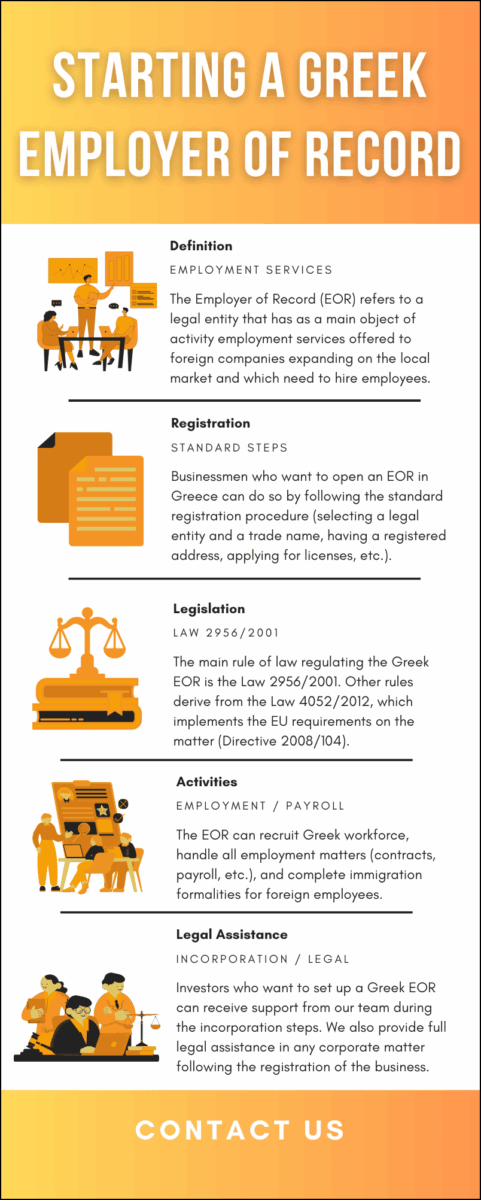
In our infographic below, you can find out details on starting a Greek Employer of Record:
What is the notice period in Greece?
Provided that the employment relationship established in a contract needs to be terminated, regardless of the reasons, the Greek law imposes certain notice periods, which are linked to the duration of employment, as follows:
- for employment of maximum 12 months, there is no notice period;
- for 1-2 years of employment, the notice period is 1 month;
- for employment ranging from to 2 to 5 years, the notice period is 2 months;
- employees who have been working in a company for 5 to 10 years have a notice period of 3 months;
- 4 months’ notice applies for employment of more than 10 years.
We invite you to contact our law firm in Greece if you want to find out more on how to register as an employer of record in this country.